Louver specifications rarely fail on appearance. They fail in the gap between a facade drawing and a shipping container — a free-area figure nobody verified, a finish that chalked within a season, or a crate that arrived with blades bent because packing was an afterthought. On export projects the specification has to carry more weight than design intent alone: it must survive fabrication tolerances, a long sea voyage, humid storage on site, and an installation crew working from drawings in a second language. The guidance below covers the three areas where louver specifications most often come undone, and how to close them before the purchase order is issued.
Start With the Performance Brief, Not the Blade Profile
A louver schedule that opens with a blade shape and a colour is a schedule that will be revised three times before approval. The performance brief comes first, because it decides which louver family is even eligible: ventilation louvres for plant rooms and car parks, weather louvres for exposed elevations, air-conditioning louvers for condenser screens and equipment yards, sun-shading louvres for glazed facades, and privacy screening where the requirement is visual rather than aerodynamic. Each of these behaves differently, and a profile chosen for looks will usually disappoint on one of them.
The first question is airflow. Specifiers should state the required free area and the acceptable pressure drop at design flow — not simply a face dimension from an architectural rendering. Louvres are a restriction in a duct, and undersized free area forces fans to work harder, raises noise, and can invalidate equipment warranties. Where mechanical plant sits behind the screen, the louver must also be checked for recirculation risk: discharge louvres placed too close to intake louvres will pull hot air back into the building regardless of how well each unit performs individually.
The second question is weather. On coastal or high-rise elevations, wind-driven rain is the governing load, and the answer is not a bigger louver but a better one — blades with integral drainage gutters, rear baffles, jamb and sill flashings, and a pitch chosen to shed water rather than funnel it inward. Combined louver banks should be detailed with continuous verticals so water cannot track between stacked sections. Wind pressure matters too: blades and frames need a stated design pressure and deflection limit, and fixings must account for suction on corners, where failures usually start.
Sun-shading and privacy screening introduce geometry rather than aerodynamics. Horizontal blades suit high sun angles on south and near-south elevations; vertical blades handle low-angle east and west sun. Screening density should be defined by the view angle the client wants blocked, not by a vague instruction to “make it private.”
Finally, verify before you fabricate at scale. A 1:1 mockup tested for airflow, water penetration and blade deflection is the cheapest insurance in the programme, and it is far easier to adjust a pitch angle on a prototype than on ten crates of finished louvres sitting at a port. Manufacturers with in-house machining and a QC lab can run these checks before release to production; it is worth asking how that verification is documented.
Material, Finish and Fabrication Tolerances That Hold Up in Service
Louvres live outdoors in the harshest position on a building — fully exposed, often at height, and usually impossible to repaint without scaffolding. Material and finish decisions therefore deserve more scrutiny than they typically receive in a value-engineering review.
Aluminium extrusions in a structural alloy are the norm for facade louvres, with blade and frame wall thicknesses specified rather than left to the supplier’s discretion. Thin blades deflect under wind load, rattle in gust conditions, and distort when fasteners are torqued. Corner construction is the other quiet failure point: mechanically crimped or screwed corners loosen over time, while welded or internally cleated corners hold alignment through thermal cycling. Fixings should be stainless steel throughout, with isolation washers wherever aluminium meets a dissimilar metal, because galvanic corrosion in coastal air is relentless and invisible until the joint has already failed.
Finish specification should name the system, the nominal film thickness, and the colour standard, then require batch consistency. Powder coatings, anodised finishes and higher-performance architectural coatings all behave differently under UV and salt exposure, and a project split across multiple production runs can easily deliver two visibly different shades of the same nominal colour. Tagging each bundle with its batch reference solves most of this at the factory gate. Specifiers working to a project-specific colour should request physical samples from the actual production batch, not a stock swatch.
Fabrication quality shows up in details that are easy to draw and hard to execute: drainage slots that actually align, mitred corners that close tightly, blank-off panels that fit without site cutting, bird and insect mesh that can be removed for cleaning, and consistent hole positions so louvre modules line up across a long elevation. In-house CNC cutting and machining, backed by dimensional and coating checks in a quality lab, is what keeps those details repeatable across a few hundred identical modules. For buyers sourcing from overseas, it is also reasonable to ask whether the supplier holds a recognised curtain wall contractor qualification, since louver banks are frequently integrated into the same facade package.
Where louvres interface with curtain wall, steel canopies or structural framing, the interface itself must be specified — who supplies the fixing brackets, what tolerance is allowed at the opening, and how the louver frame closes against waterproofing. Interfaces left to site resolution are the most common source of leaks and callbacks on export jobs.
Export Packaging, Submittals and Site Sequencing
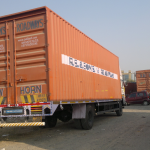
Everything described above can be executed perfectly and still arrive on site unusable if the packing strategy is an afterthought. Export louvres are long, thin, finished components, which makes them exactly the wrong shape for casual handling. Sea crating rather than loose bundles, full-length protection on blade edges, corner protectors, and a moisture barrier with desiccant are baseline requirements for a multi-week ocean transit through changing humidity.
Labelling matters as much as cushioning. Each crate should be marked against the elevation or unit reference used on the approved shop drawings, so the site team can move a crate directly to the opening it belongs to instead of opening everything to find out what is inside. A packing list that mirrors the drawing register, plus a small allowance of spare blades and fasteners, saves weeks on a project where replacement parts mean another shipment. Container loading plans should confirm that the longest modules are not used as structural members for the stack above them.
Submittals deserve the same discipline. Structural calculations for the louver assembly, finish samples, shop drawings showing fixing and interface details, and an operation and maintenance guide for cleaning and mesh replacement should all be approved before production release. Language and time zone differences make a single, clearly named technical contact on the supplier side genuinely valuable — someone who can answer a bracket question within a day rather than a week.
Site sequencing is the last consideration and one of the most overlooked. Louvres installed before wet trades are finished collect dust, mortar and paint overspray that is difficult to remove from a coated blade. Where early installation is unavoidable, protective film should stay in place and be removed within the manufacturer’s recommended window. For project teams comparing ventilation, sun-shading and screening configurations alongside fixing details, it helps to learn more about the available louver systems before locking the schedule, since blade geometry, frame depth and connection methods are decided together and rarely revise cleanly once fabrication drawings are issued.